The Return of the Charrette
In one of my recent courses, I was - for the first time - asked to add an 'AI policy' clause to my syllabus. Here's what I came up with:
AI Policy
Whenever you think about using AI, replace the word AI with computer. If the sentence suddenly sounds outdated, go ahead and use AI. If it still sounds exciting, please report your discovery to the instructor immediately.
I hoped the lone student who actually read the syllabus all the way through would at least smile. But this was not only a joke.
As an architecture student in the early 2000s, I was not allowed to use a computer. For the first two years of the B.Arch program, our Foundations director, a Soviet-trained architect who seemed ancient to us at the time (he was probably no older than 40), demanded at least '3,000 drafting hours' before we could touch digital tools. And so we drafted.
But I could not help myself. It was the early days of the World Wide Web, and everywhere I looked there was architectural mischief: 3D renderings, CAD drawings, CAM models, generative forms, and representations that seemed to arrive from the future. Late at night, I started running a shadow version of each of my projects. There was the official version, drawn with pencils and T-squares, and there was the other one, never meant to see daylight, built in SketchUp, Maya, 3ds Max, AutoCAD, and whatever else I could lay my hands on.
Slowly, the shadow project started leaking into the official one: a rendering here, a 3D diagram there. Some faculty noticed. Then people started offering me freelance work. By the end of the first year, I had a part-time job. By my third year, I was working full time.
Was I right? Was my professor right?
The Death of Homework
There are many faces to the current crisis in academia: politics, relevance, a brutal job market, and now the almighty rise of AI. The concerns of my Foundations professor suddenly echo in the worries I hear from colleagues all across academia. With AI, many of the traditional forms of academic evaluation no longer work the way we pretend they do. The take-home essay, the research paper, the weekly response, the coding assignment, and the design brief were all built on the fragile assumption that the submitted artifact is evidence of thinking. AI has broken that assumption.
Academic work has always been a proxy for learning. Since we cannot observe the process of learning directly, we have relied on the artifacts students produce as indirect evidence of knowledge. Students, on the other hand, have always found ways to exploit this gap through the creative practice we usually call cheating. So when the first versions of ChatGPT emerged during the pandemic, academia reached for the centuries-old label to describe a new threat: if you did not write it, it is not your work, cheater.
But the problem cannot be reduced to cheating. In the past, most assignments were indirect evidence of knowledge and skill: we looked at the paper and inferred the process; we looked at the answer and inferred the struggle; we looked at the project and inferred intellectual ownership. AI divorces the artifact from the process and that inference is no longer reliable. In a last-ditch effort, some educators want to bring back handwritten exams, closed classrooms, and supervised tests. I understand the impulse. An in-class exam is where students cannot ask AI to produce the answer for them. It can show whether they can retrieve, compress, and reproduce something they studied at home. That is not nothing, but it is also not enough.
A pen-and-paper test measures a very narrow slice of student capability: recall, composure, speed, memorization, and the ability to extract digested knowledge on command. It does not show proof of effort, ownership, or the student's ability to build an idea, revise it, apply it to a messy situation, explain the tradeoffs, and recover from failure.
The Return of the Charrette
What if the goal of education is to develop good judgment? The problem with take-home work in the age of AI is not that students work outside class. They should work outside class. They should build projects, write, design, research, experiment, fail, revise, and develop ideas over time. Serious work needs duration, privacy, wandering, and obsession. The problem is work that arrives in class as a finished artifact without context. Polished but not understood, submitted but not owned.
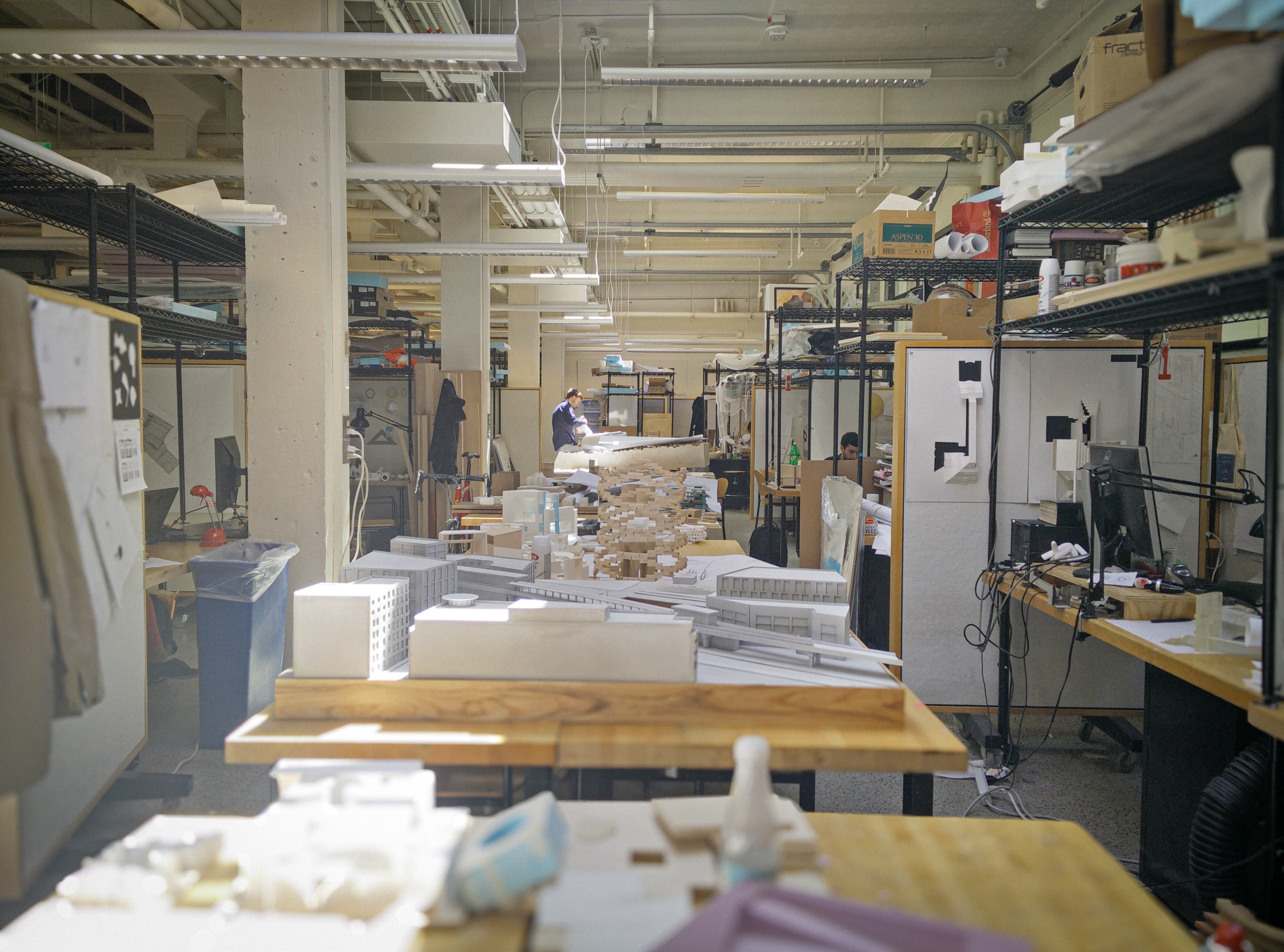
This is why academic education should learn from the architecture studio. For centuries, studio has been the spine of architectural education. Students take one almost every term, sometimes completing ten different studios before graduation. Each studio can meet for half a day, twice a week, and everything else in the curriculum - history, theory, structures, representation, technology - is supposed to feed the project on the wall. The studio is not a class in the traditional sense. It is a workshop, a laboratory, a place to make, test, and revise ideas. It is messy, iterative, and collaborative.
The dreaded charrette - French for "cart" or "chariot" - is traced to the Ecole des Beaux-Arts, where a cart was pushed through the studios to collect the drawings of exhausted students. The charrette is the concentrated burst inside the studio: making, pinning up, explaining, getting feedback, revising, and trying again. Studio is the marathon; the charrette is the sprint.
In architecture education, students are rarely evaluated by what they submit. Even a great drawing, a pristine physical model, or a shiny 3D rendering is not enough if the student cannot stand with the work, defend it, respond to critique, and revise it. The assessment is of the student's relationship to their work. And this happens dozens of times during the term: in pin-ups, desk crits, impromptu reviews, and those strange moments when a guest suddenly appears and everyone has to explain their work on the spot.
Demonstrating ownership in the studio is much harder to fake. If you taught one, you know that within five minutes it is often clear whether a student owns the work or has merely assembled it. Students who own their work can move around inside it. They can explain decisions, respond to unexpected questions, name doubts, and connect the project to readings, precedents, and constraints. They have context and agency.
Every architectural firm in the world has shelves filled with reference material, precedent studies, and design examples. When those are inherited into a new project, they are not simply copied, and the designer is not "cheating" their way through the commission. But if they are only copying, if they do not understand what they borrowed or why, it becomes apparent in a heartbeat: here is a wannabe Mario Botta, but the masonry is wrong; here is a copycat Alvaro Siza, but the proportions are off.
Demo or Die, Again
When I joined the MIT Media Lab, the "demo or die" provocation - which emerged as a reaction to academia's "publish or perish" culture - was setting the tone across the building. Instead of only imagining possible futures, everyone was expected to go ahead and build a piece of it. Let people touch it, question it, misunderstand it, break it, and ask why it matters. More than half of our lab space is designated for these prototypes. This is inefficient, almost irresponsible, and certainly expensive, but it is also the most important space in the lab. It is a workshop, a studio, a charrette, a stage, and a testing ground in which artifacts serve as catalysts for conversation.
Sometimes a mayor, minister, company executive, or head of state walks in and points at a half-baked tangle of wires, sensors, and noisy actuators and asks: What is this thing? Why does it matter? What problem does it solve? Why did you build it this way? And then a researcher - who sometimes arrived in the States a few weeks before, still struggling with jet lag and language - has to demonstrate ownership.
The demo space does not replace traditional instruction at MIT. Students still go to classes, take exams, and publish papers. But the good students in our group spend the vast majority of their time and effort in that room. They turn inherited knowledge into something they can test, explain, defend, and improve. Courses serve as a foundational framework, but the demo space is where the work becomes work.
Demo culture and the charrette are cousins. Both insist that knowledge has to stand up, not as performance for its own sake, but as proof of ownership and a demonstration of judgment. A student in a demo space is not only building something for others to review, but also learning to communicate it, locate its weakness, defend its choices, absorb critique, and return to the project with sharper judgment.
In this moment of knowledge abundance, the same logic should travel beyond architecture studios and demo spaces. A history student might submit a paper, but also present a source map, a timeline, and an oral defense. A computer science student might walk through code architecture, debugging decisions, and tradeoffs, instead of memorizing tree traversal algorithms. AI can be a central part of all of these learning processes, but it cannot replace command of the work.
All Models Are Wrong
None of this means the studio model is perfect. Architecture education has its own pathologies, and I have no interest in romanticizing them. Studio critique can reward confidence more than insight. It can privilege students who speak fluently, perform well in public, or know how to frame their work persuasively. Some students produce excellent work but struggle to explain it under pressure. Some are shy. Some think visually, materially, or quietly before they think verbally. A live critique can reveal understanding, but it can also misread silence as weakness.
There is also the problem of power. In a studio review, too much authority can sit in the hands of one instructor, one critic, or one charismatic jury member. Taste can disguise itself as rigor; style can be mistaken for intelligence. A strong personality can dominate the room. Students may learn to satisfy the critic rather than develop their own judgment.
But this does not make the traditional model equally useful. In the age of AI, many of our old evaluation formats are either obsolete or much narrower than we like to admit. The studio environment, at its best, already contains many of the qualities traditional education is trying to protect. It has memory, argument, writing, technical skill, evaluation, and rigor, but these are distributed across conversation, presentation, pin-up, review, revision, and demonstration. It is less tidy than an exam, harder to standardize, and therefore more demanding for the instructor. But it might be the only way to teach judgment, agency, and ownership when the artifact alone no longer proves ownership.
Studio as a Habit
Back to the course with the AI policy. At the end of the year, when I received the student evaluations, two comments stayed with me. One student complained that the course was too "design studio heavy." Another wrote that it focused too much on presentations and public speaking in class.
I read those comments and thought: good.
These students were naming the goal exactly. The course did ask them to stand up, present, explain, revise, defend, and return to the work. It asked them for judgment, agency, responsibility, and ownership. For now, AI cannot do that.